Plagiocephaly
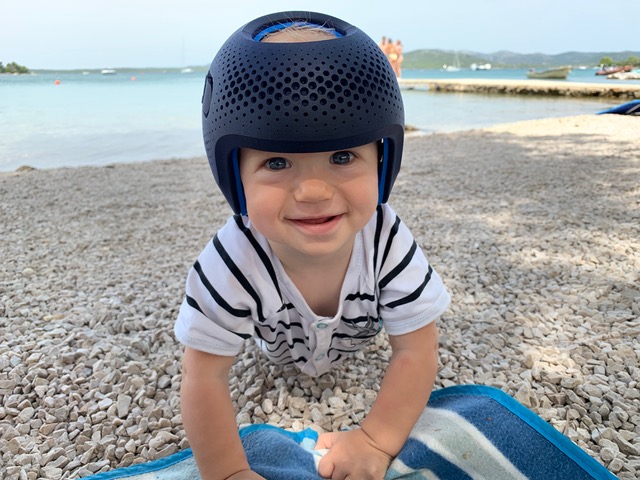
This common condition is very treatable using repositioning techniques or a Talee® cranial remolding orthosis to gently correct your baby’s head shape.

When you first hear the word plagiocephaly, it can be scary. It’s a big word that’s usually accompanied by other scary words like deformity, disorder and cranial remolding. We’re here to help set you at ease.
Plagiocephaly, also known as Deformational Plagiocephaly, Positional Plagiocephaly or Flat Head Syndrome, is a very common condition where an infant’s soft skull becomes flattened in one or more areas. This is usually caused by infants sleeping regularly in one position, or by other situations where the infant’s head remains in one position for long periods: strollers, car seats, swings, and so on.
Plagiocephaly affects nearly one in two infants. Physicians, clinicians and therapists recommend that one in ten infants be evaluated and treated. In some cases, plagiocephaly is sometimes accompanied by a condition known as Torticollis. Infants who favor one side of the head may experience shortening or tightening of the sternocleidomastoid (SCM) muscle, which limits the range of motion and can cause the head to tilt or turn to one side.
We understand this is still sounding scary, but the reality is it’s all very treatable with a few methods.
As parents, we’re concerned that this might be uncomfortable for an infant or even painful. We can be embarrassed to take our infants out in public for fear of awkward questions or judgment. Infants are highly adaptable and can even grow to love their Cranial Helmets. We always adjust them for the correct fit and give you an after-hours number to contact the orthotist directly if you have questions in the evening or at night. We can also take comfort in the fact that society has changed its view of corrective braces, with many parents decorating their child’s cranial helmet with letters or having it painted with cool patterns.
Babies have free floating plates of bone in their skull that are loosely connected with fibrous tissue known as sutures. When exposed to prolonged pressure, asymmetry or flat spots of the head can occur, this is known as plagiocephaly.
Some factors of increased risk for plagiocephaly are:
Plagiocephaly is defined in three common types of head shapes, usually easiest to see looking from the top down.
Plagiocephaly shows as an uneven or asymmetrical head shape. The back of one side will be flattened, sometimes pushing the forehead and ear on the same side forward. One ear or eye may show higher than the other.
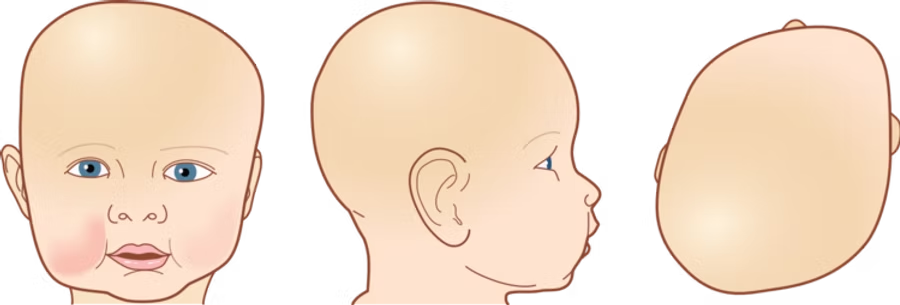
Brachycephaly shows as an abnormally wide shape of the head as a result of a central flattening of the back of the head. Back of the head may increase in height and forehead may bulge when viewed from the side.
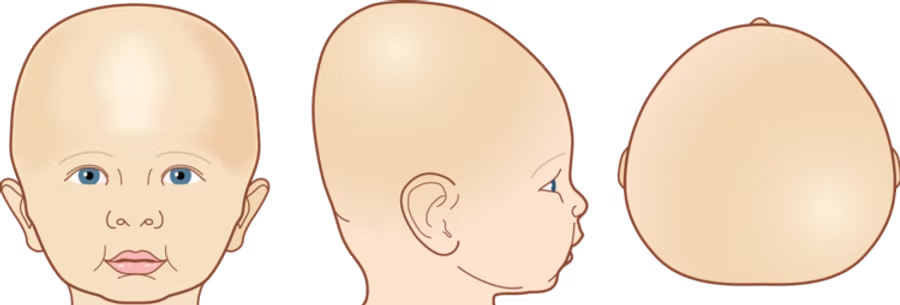
Scaphocephaly shows as a long, narrow shape of the head looking down from the top. Forehead may bulge as well as the back when viewed from the side. This is more common in premature babies.
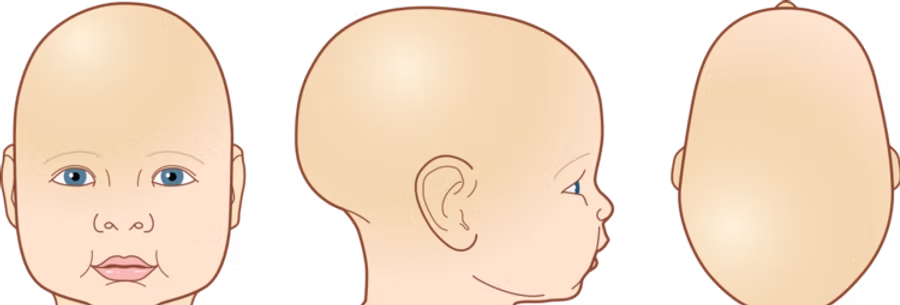
Craniosynostosis is a rare condition where one or more of the fibrous tissues between the bony plates in an infant’s skull fuse or close prematurely before the baby’s brain is fully formed. The brain continues to grow, giving the infant’s head an asymmetrical or misshapen shape or appearance. Sometimes a raised, hard ridge is felt along prematurely closed sutures.
Craniosynostosis typically involves the premature closing of one suture, but can involve more, resulting in Complex Craniosynostosis.
Treatment for craniosynostosis requires surgery to allow the sutures to close properly and allow the brain to grow normally. Early diagnosis and intervention are essential in allowing your baby’s brain to develop normally. The vast majority of plagiocephaly cases do not involve craniosynostosis.
Congenital Muscular Torticollis, also known as ‘wry neck’ is a condition where an infant has an abnormally shortened and tight neck muscle that causes the head to tilt to one side while rotating the chin to the opposite shoulder. Babies with torticollis have a limited range of motion in the neck and will usually hold their head in one position which can lead to plagiocephaly.
Torticollis is common in newborns and can be present at birth, or can take up to three months to develop. Some causes of torticollis include the baby’s position in the womb before birth, abnormal development of the sternocleidomastoid (SCM) muscle, or trauma or damage related to birth.
Treatment usually involves a physical therapist and some neck re-positioning and stretching exercises to help stretch the SCM muscle.
If you’ve noticed that your infant’s head has a flat spot or asymmetrical shape in need of evaluation, it can be worrisome and bring up even more questions. How do they evaluate my baby? Will it be painful? If my baby has plagiocephaly, how do they treat it? Will the orthotist listen to my concerns and answer my questions?
It begins with you, the caregiver. We know your first time visiting can be nerve-wracking as you worry whether your infant is OK. Some of us here at Strive O&P have been in your position and personally understand the feelings that a parent has when confronting a strange and scary diagnosis.
Evaluations are always pain-free, as is the treatment. We begin with basic history: our orthotist does some hand measurements and learns how and when the plagiocephaly was first noticed. We measure the head from several angles to determine severity of the condition. Once we’ve gathered all of the required information, your orthotist will discuss treatment options with you.
If your baby is less than four months old and in the 95th percentile of mild or least severe cases, the orthotist will discuss re-positioning techniques to help improve your baby’s head shape. Re-positioning involves varying the position of your baby’s head during feeding, playing and sleeping, as well as use of tummy time. We will still recommend that you place baby to sleep on their back, as it dramatically lowers the risk of SIDS.
If your baby is over four months old and has moderate or severe plagiocephaly, re-positioning is unlikely to be effective and the baby’s head will retain the flat shape unless other therapies are used.
When moving beyond re-positioning, we do an assessment scan to provide a baseline and an accurate 3D image of your baby’s head shape. This is completely painless. Most often the baby sits on your lap while we use a small handheld scanner that does 3D imaging without the use of lasers.
If the asymmetry is moderate or severe, the orthotist will recommend therapy using a Talee® Cranial Remolding Orthosis (CRO), also known as a Cranial Band, Cranial Remolding Helmet, or Baby Helmet.
The Talee® CRO gently reshapes the head by encouraging the skull to grow to proper proportions. Talee® is made from lightweight, 3D-printed plastics for maximum comfort and is free of pain and discomfort for your baby. The remolding orthosis is made from our scan, so it fits your baby’s head shape exactly and is ready within 14 days of your initial scan.
At the end of the evaluation, if a scan was done, we send you home with a copy of the data so you can review it later. As treatment progresses, we will see your baby every 4-5 weeks to do measurements and adjust the shape of the orthosis to promote maximum growth. Our goal is always 100% correction, which can take between 3-5 months.
We are always here to help. If you have a question after hours, we provide a number so you can speak directly with the orthotist. Worried about a small red spot? You can text a photo to the orthotist and they can advise you over the phone.
At the end of treatment, we do a final scan and send one home with you as well as sending a full symmetry report to your pediatrician or referring physician.
We understand that a diagnosis for Plagiocephaly can be worrisome and scary. Hearing that your baby may need ‘helmet therapy’ can bring on a wave of questions and worries. Rest easy, we’re parents first and clinicians second. We’ve sat on the other side of the desk and had the same fears and worries when our first son was diagnosed with Plagiocephaly and our second had it as well. We’re here to give you the tools to handle and treat the Plagiocephaly diagnosis and answer any questions you may have during the process.
What is Plagiocephaly?
Plagiocephaly is a common and highly treatable condition where asymmetry or flat spots occur separately or together on your infants head. The two main types of Plagiocephaly are Positional Plagiocephaly, which occurs in nearly 50% of infants, and Congenital Plagiocephaly, also known as Craniosynostosis. Craniosynostosis is a rare condition where the sutures in the infants head close prematurely and can require surgery to correct.
Why is Plagiocephaly becoming more common?
Starting in 1992, the American Academy of Pediatrics and National Institutes of Health introduced the ‘Back to Sleep’ campaign, now known as “Safe to Sleep’ and the result was a dramatic decrease of over 50% in SIDS related deaths. Since this time the percent of infants with deformational plagiocephaly has increased. Even though Plagiocephaly has increased, the safest way to put your baby to sleep is still on their back.
How do I know if my baby has Plagiocephaly?
Sometimes ‘flat’ or asymmetrical spots are visible, and sometimes as parents we have a hard time seeing them. If you are concerned about the symmetry or shape of your child’s head, contact your pediatrician, or call us to schedule a free evaluation. We work with your pediatrician, physical or occupational therapist or family physician to achieve the best possible outcome for your little one.
Can Plagiocephaly be prevented?
Absolutely. Re-positioning techniques, supervised tummy time, less frequent use of strollers in favor of front chest carriers, and not leaving infants in car seats when not in a motor vehicle can all help prevent Positional or Deformational Plagiocephaly. Placing your infant on it’s chest for sleep is not recommended as the risk of SIDS increases.
How is Plagiocephaly evaluated?
We use the latest portable 3D scanning technology so the experience is painless and fuss free for both the parents and the infant. We often have the infant sit in your lap during the scan and it’s very fast.
I’m feeling a little overwhelmed, will the orthotist answer my questions?
Of course, that’s what we’re here for. As a parent, you’re part of the integrated health care team and we want you have as many tools as possible to help.
How is Plagiocephaly treated?
In some very mild cases, early intervention by using re-positioning techniques can correct Plagiocephaly. If not, we use the Ottobock MyCro Cranial Remolding Orthosis, also known as a Cranial Remolding Helmet or Baby Helmet.
What age do you recommend starting treatment for Plagiocephaly?
We recommend starting treatment in a cranial remolding helmet at 3-4 months old, but we can begin evaluation and monitoring as early as 1 month old. Starting early allows us to help find solutions to prevent the use of a cranial remolding orthosis.
What ages can use the MyCro Cranial Remolding Orthosis?
Ottobock MyCro is FDA approved for ages 3-18 months and can be used past 18 months with written explanation from your pediatrician or referring physician.
Will the MyCro be uncomfortable or hurt my baby?
This is the most asked question we receive. The cranial remolding orthosis or helmet does not cause any pain or headaches, and does not hinder the normal development and growth of your baby. Babies are highly adaptable and adjust very quickly. Most babies take 1-4 days to adjust to wearing the orthosis. We have a slow break-in wearing schedule to get you and your baby used to wearing the helmet without any issues. We adjust the orthosis regularly to fit exactly as needed and to be comfortable and not too tight for your infant.
Are infants just as happy when wearing the MyCro orthosis?
Absolutely! The MyCro orthosis does not affect the personality of your infant. You’ll have the same happy baby you’ve always had! Babies often grow attached to their MyCro orthoses.
How long will my baby have to wear the MyCro orthosis?
We start the first week on a limited schedule then we always recommend 23 hours a day wear for the MyCro orthosis. Average treatment time is 3-6 months for 90-100% correction.
So my infant sleeps with the MyCro orthosis on?
Yes. We recommend giving your infant a one hour break before bedtime to properly clean and dry the MyCro orthosis before they go to sleep. To have successful correction, your infant needs to wear the band when the full 23 hours daily.
What if I notice red or irritated spots?
If you have an area that is getting red, and it doesn’t go away after 45 minutes after removing the MyCro orthosis, then remove the orthosis until you can reach the orthotist. Our orthotist is available after hours to answer your questions for just such cases and we provide you with a direct contact number to that person.
Is more information available?
You can contact your pediatrician, family doctor, occupational or physical therapist or call us at 586-803-4325 and schedule a free evaluation. We’d be happy to answer any questions you may have.
Are there any websites for support or with more info?
Please see the Plagiocephaly Resources tab on this page for more information.